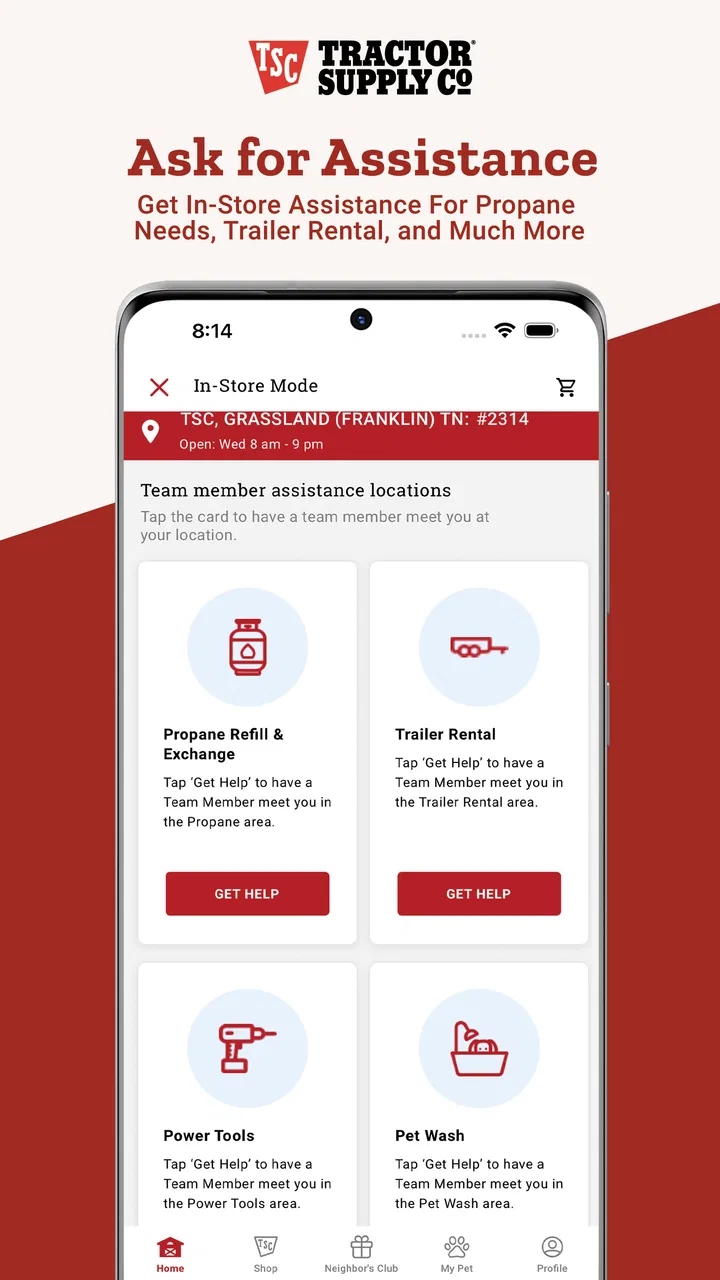
Tractor Supply Company
- 4.0
- Rating
- 1.00M
- Installs
- Free
- Price

 Analysis by App-foxy
If you shop for feed, fencing supplies, tools, workwear, or everyday farm and rural-living essentials, Tractor Supply Company is the kind of shopping app that can save a trip when you already know what you need. I found it most useful as a practical companion to the retailer’s stores rather than as a replacement for visiting one. The experience is centered on browsing the catalog, checking whether an item suits a particular job, and deciding whether ordering or an in-person visit makes more sense.
The app is free, aimed at everyone, and comes from Tractor Supply Company. It belongs to the shopping category, but its audience is more specific than a general marketplace user. Someone looking for a garden hand tool, animal-care item, outdoor clothing, or a replacement part will get more value from it than someone who simply wants the broadest possible online selection. My overall impression is positive: it makes a specialized store easier to navigate, although the usefulness of the experience depends heavily on how clearly you know the product or task you are shopping for.
What to expect before you start shopping
The first thing I would tell a new user is not to treat this as a generic shopping app with a rural theme. Tractor Supply Company has a focused catalog, and that focus is its main advantage. Instead of sorting through unrelated sellers, I could begin with the kinds of departments I would actually expect from a farm-and-home retailer: supplies for animals, outdoor work, property maintenance, clothing, tools, and seasonal needs.
You May Also Like

 Blood Strike: 2.5 Anniversary
Blood Strike’s Loadouts Turn Every Drop Into a Tactical Gamble
A close look at Blood Strike’s custom loadouts: how fast access to signature weapons reshapes its battle royale rhythm, rewards preparation, and narrows the gap between fights.

 Pandora - Music & Podcasts
Pandora’s Music Is Easy to Start, but Harder to Recover
Pandora’s strength is its low-effort path from a seed to a station. Its weak spot is how much confidence it asks you to place in connection, setup, and quiet recovery.

 8 Ball Pool
 Is Built on Rivalries, Rematches, and Routine
A close look at the rivalries, rematches, shared routines, and unanswered safety questions that turn a quick pool match into a persistent mobile community.

 Samsung Music
’s Quiet Strength Is Playing What You Already Own
Its reach comes less from spectacle than from dependable access to a personal library. That simplicity is both the app’s strongest retention engine and its ceiling.

 AccuWeather: Weather Radar
AccuWeather Review: A Quick, Clear Forecast for Everyday Decisions
For everyday plans, the best forecast is the one you can understand quickly. AccuWeather makes rain timing, radar, and local conditions easy to act on, with a few trade-offs.

 Hill Climb Racing
Why Hill Climb Racing Still Turns Crashes Into One More Run
A tiny car, a bumpy hill and one more upgrade: Hill Climb Racing keeps resurfacing because its simple chaos makes every near-miss feel personal.
More From Our News Desk



That focus also creates a trade-off. If you are buying a common household item and care mainly about the lowest price or the largest selection, a broad marketplace may be faster. This app makes more sense when the store itself is a likely destination, especially if you want to compare products that belong to the same practical category. I would use it before driving to a store, not after I had already decided that a visit was unnecessary.
The store listing presents the app as “The Only App For Life Out Here,” while the short description identifies it simply as Tractor Supply. I would not read that wording as a promise that the app covers every rural task. In practice, its value comes from helping me organize a purchase around the retailer’s assortment. That is a more useful expectation than assuming it will provide expert answers for every repair, livestock, gardening, or property question.
Its public reception is encouraging, with a 4.2 average from around seventeen thousand ratings and roughly 4.2 thousand written reviews. More than a million people have installed it, so it is not an obscure experiment. Those figures suggest a well-established shopping tool, but they do not guarantee that every product search or store visit will feel equally smooth. My own advice is to judge it by your shopping routine: frequent Tractor Supply customers have more reason to keep it than occasional visitors.
One subtle benefit is that the app can help turn an unstructured errand into a short checklist. Before opening it, I might only think, “I need something for the fence.” Inside the catalog, that vague need can become a search for a specific hardware item, a tool, or a related supply. That does not replace measuring the job or checking compatibility, but it can prevent the common mistake of wandering through a store without knowing which product type to compare.
Who will get the most from it
I see the strongest fit for people who shop at Tractor Supply repeatedly, live close enough to one of its stores to make pickup or a quick stock check useful, or regularly buy supplies across several departments. It can also help a first-time customer who wants to browse before entering a large store. Seeing the available product categories in advance gives the visit a clearer purpose.
It is less compelling for someone who rarely shops at this retailer, needs highly specialized professional equipment, or expects a shopping app to provide detailed technical guidance. I would also skip installing it solely for one impulse purchase if the same item is already easy to buy elsewhere. The app earns its place when it reduces uncertainty or saves time across more than one shopping trip.
First setup: making the first session useful
After installing it, I would begin with a simple goal rather than browsing every department. Pick one real task, such as preparing for a weekend repair, finding work clothing, or restocking animal supplies. This gives the first session a clear finish line and makes it easier to tell whether the app is helping. A vague tour of the catalog can feel busy without producing a useful result.
The app runs on Android devices using version 6.0 or later. That broad compatibility is helpful if you use an older phone for work or keep a separate device in a truck or workshop. The current version is 1.60.4, so I would make sure the installed copy is current before judging a problem as a permanent limitation. A current app can also make the first search less confusing than an outdated installation.
For setup, I recommend starting with the store and product task you care about most. If you are planning a store visit, identify the relevant location before you become invested in a product choice. A product that looks ideal in a general catalog view may not be equally convenient for your nearest store. This is one of the most important habits for avoiding wasted time: decide whether your goal is browsing, buying for delivery, or preparing for pickup, then evaluate products through that lens.
I would also keep a note of the exact dimensions, model information, or quantity needed for the job before searching. This matters especially for hardware, replacement items, and animal-care products, where a visually similar choice may not be suitable. The app can help me find candidates, but it cannot measure my fence, inspect my equipment, or decide whether a product fits a setup I have not described carefully.
A useful first-session workflow is to search for one item, open the product information, compare it with a second candidate, and then stop to decide whether the purchase belongs in the app or in the store. That small pause is valuable. Shopping apps encourage quick taps, while practical purchases often need a physical check, a measurement, or advice from someone familiar with the task.
Finding a first meaningful result
My preferred first action is not placing an order immediately. It is finding one realistic item and taking enough information from the listing to make a confident next decision. For example, if I needed a new pair of work gloves, I would search the relevant category, compare the intended use and available options, and decide whether the app has narrowed the choice enough for me to buy or visit a store.
This approach works because the first success is not necessarily a completed checkout. It may be a saved plan for a store trip, a clearer shortlist, or confirmation that the retailer carries the kind of item you need. For a first-time user, that is reassuring: you do not need to understand every part of the app before it becomes useful.
For a more involved purchase, I would use a three-pass method. First, search by the task rather than by a brand name if you are unsure what category you need. Second, compare at least two plausible products instead of accepting the first result. Third, return to the practical question: can I use this item as intended, and is obtaining it through this retailer more convenient than my usual alternative?
The non-obvious advantage here is that the app can act as a pre-visit planning tool. I can build a mental route through a shopping trip by identifying the departments or product types involved before leaving home. That is especially useful when a task combines supplies from different parts of the store. The limitation is that a catalog view cannot fully communicate size, texture, weight, or build quality, so I would still prefer an in-person check for products where those details affect the decision.
A realistic everyday scenario
Imagine that I notice a section of fence needs attention on a Saturday morning. I measure the affected area, write down the kind of fastener or tool involved, and open the app before heading out. I search for the product category, compare a couple of options, and use the results to decide whether I should visit a Tractor Supply store or choose another purchasing route. If I also need gloves or a small outdoor tool, I can check those needs during the same planning session rather than remembering them only after arriving.
The app is valuable in that scenario because it reduces the chance of making an uninformed trip. It does not solve the repair itself, and I would not rely on a product thumbnail to confirm compatibility. The meaningful success is leaving home with a realistic shopping plan. If the store visit is convenient, the app has done its job even if I ultimately inspect the product in person before buying.
Common confusion and where the experience needs care
The biggest source of confusion for new users is the difference between finding a product and knowing that it is the right product. A search result can be relevant without being suitable for the exact job. I would be especially careful with replacement parts, fittings, animal-related supplies, and anything where size or material matters. Compare the details with the equipment or task in front of you, not just with the product photo.
Another point of friction is deciding whether the app is being used for online shopping or store preparation. Those are related but different jobs. Online shopping prioritizes a complete purchase journey. Store preparation prioritizes confidence that the trip will be worthwhile. If I mix those goals, I may become frustrated when a product that looks attractive still requires an in-person decision or a separate check before I commit.
I would also avoid assuming that every product category deserves the same level of trust in a digital listing. Clothing sizes, tool ergonomics, and materials are easier to judge physically. Conversely, a straightforward repeat purchase may be ideal for app-based shopping because I already know what I want. This is where the app compares favorably with a general marketplace for repeat shoppers: the retailer’s focused assortment can reduce irrelevant choices, but it does not remove the need for judgment.
Compared with visiting a store without preparation, the app gives me a faster way to form a shortlist and remember the purpose of the trip. Compared with a broad online marketplace, it offers a more specialized shopping environment but usually a narrower reason to open it. Compared with a retailer’s desktop website, a phone app is more convenient while standing in a garage, barn, garden, or vehicle, although I may prefer a larger screen when comparing several detailed product pages.
There is also a practical reason not to overuse it: browsing can become a substitute for planning. I could spend time moving between categories without confirming measurements, quantities, or the actual problem I am trying to solve. My fix is simple. Keep the physical task in view, write down the requirements first, and use the app to support that list. That turns it from a distraction into a shopping instrument.
The app is free, which removes the usual cost barrier to trying it. Still, “free” does not mean every purchase decision becomes risk-free. I would still compare the total convenience of buying through Tractor Supply with shopping locally, using a specialist supplier, or checking another retailer. A lower-friction app is not automatically the best choice when the item requires expert fitting or immediate hands-on inspection.
Questions I would answer before keeping it installed
Would I recommend it to a first-time Tractor Supply shopper? Yes, if that person has a concrete need and expects to visit the retailer more than once. I would open it before the first trip, search for the main item, and use the result to plan questions or measurements. I would not promise that it will make every specialized purchase simple.
Is it useful without being an expert in farm or outdoor supplies? Yes, but beginners should search by the task they understand and then verify the product choice carefully. The app can expose relevant categories and alternatives, which is a good starting point. It should not be treated as a substitute for learning what the job requires.
Should someone use it instead of the usual marketplace? Only when Tractor Supply is already a sensible source for the purchase. The focused catalog is an advantage for its own categories, while a broad marketplace may be better for unrelated household goods, unusual parts, or aggressive price comparison. I would choose based on the item, not loyalty to one shopping format.
Can it replace a store visit? Sometimes it can reduce the need for one, particularly for familiar repeat purchases. For products where feel, fit, dimensions, or compatibility matter, I would use it to prepare and then inspect the item in person. That hybrid approach is where I found the app most convincing.
Is it suitable for every phone user? Its Android requirement of version 6.0 or newer covers many devices, including older ones, but the quality of the experience will still depend on the device and connection available during the shopping session. If you use an older work phone, test the basic browsing flow before relying on it for an urgent trip.
My next-step recommendation
After the first successful search, I would not immediately explore every feature. I would use the app for one repeatable routine: check a planned purchase before leaving home, compare a small number of suitable options, and decide whether to buy digitally or visit a store. Once that routine feels natural, it becomes easier to use the app for seasonal projects, clothing, tools, and recurring supplies without turning each session into an open-ended browsing exercise.
The developer, Tractor Supply Company, has built a focused shopping tool for a focused retail audience. That is both its strength and its boundary. I appreciate that it can support the practical steps around a purchase, especially when I want to prepare for a store visit. I also think users should keep their own measurements, product knowledge, and judgment at the center of the process.
My final recommendation is straightforward: install Tractor Supply Company if you already shop at the retailer or have a specific farm, outdoor, animal-care, or property-maintenance purchase in mind. Start with one task, identify the store or buying route that fits it, and use the catalog to create a shortlist rather than browsing aimlessly. Skip it if you rarely use Tractor Supply or mainly want a universal marketplace. For the right shopper, the app is most valuable as a bridge between planning at home and making a smarter purchase in the real world.
FAQs for Tractor Supply Company
01What is Tractor Supply Company’s app used for?
The Tractor Supply Company app is designed to provide users with a seamless shopping experience for farm supplies, home improvement products, outdoor living essentials, and more. It offers features like real-time inventory updates, order tracking, and exclusive deals. Users can also find store locations and access customer service directly through the app.
02Is the Tractor Supply Company app free to download and use?
Yes, the Tractor Supply Company app is free to download on both Android and iOS platforms. While the app itself doesn't have any hidden costs, users will need to make purchases for the products they choose to buy. Some exclusive deals and offers may be available only to app users.
03How does the app enhance my shopping experience at Tractor Supply Company?
The app enhances your shopping experience by providing features like personalized shopping lists, barcode scanning for quick product information, and the ability to check local store inventory in real-time. Additionally, it offers user reviews and recommendations to help make informed purchasing decisions, along with access to special promotions.
04Can I manage my Tractor Supply Company account through the app?
Yes, the app allows users to manage their Tractor Supply Company accounts. You can view your purchase history, track orders, and update your profile information. The app also enables you to save payment methods and set preferences for future shopping experiences, making transactions quicker and more convenient.
05What should I do if I encounter issues with the Tractor Supply Company app?
If you encounter any issues with the app, it is recommended to first check for updates and ensure you have the latest version installed. If problems persist, you can contact Tractor Supply Company’s customer service through the app or visit their website for support. They offer various channels to assist with technical difficulties or account-related inquiries.
Pros
- User-friendly interface for easy navigation.
- Wide range of products for rural living.
- In-app exclusive discounts and deals.
- Seamless online ordering and pickup options.
- Comprehensive product information available.
Cons
- Limited international shipping options.
- Occasional app performance lags.
- Some features require account creation.
- Limited payment options in app.
- Infrequent updates to the app.

Tractor Supply Company
Gallery